The HOPE Lab hosts its first international conference
Faculty and graduate students exchanged ideas and presented research on the pulse of humanitarian operations.
Published: March 10, 2026 / Author: Danna Lorch (MA '03)

Professor Gloria Urrea and other attendees discuss humanitarian research at the HOPE Research Workshop. (Photo by Peter Ringenberg/University of Notre Dame)
When the Humanitarian Operations Lab, or HOPE Lab, launched at the University of Notre Dame’s Mendoza College of Business in 2023, it was designed to build and disseminate actionable knowledge through research into humanitarian operations management.
That’s a mission that’s becoming increasingly urgent today. The extreme funding cuts following the termination of USAID, the climate crisis, food insecurity and ongoing armed conflicts all pose operations dilemmas far more complex than those faced in the recent past.
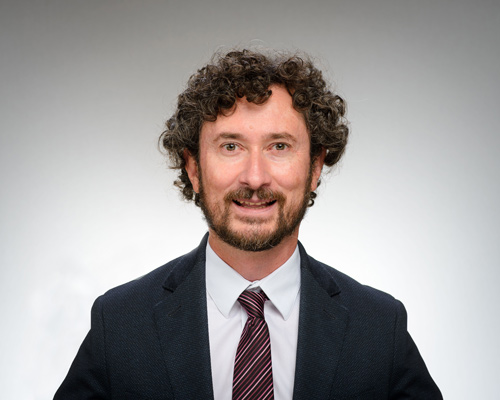
Alfonso Pedraza-Martinez (Photo by Barbara Johnston/University of Notre Dame)
While there are other labs with a similar goal to HOPE in the United States and across Europe, just a handful of them are based at a business school — an environment that lends itself to outside-the-box collaborations across sectors. Alfonso Pedraza-Martinez leads the HOPE Lab and the Meyer Business on the Frontlines program at the Mendoza College of Business. From the beginning, the Greg and Patty Fox Collegiate Professor of IT, Analytics, and Operations made it a key objective for HOPE to host a workshop aimed to bring together faculty and graduate students to build a global community of humanitarian operations scholars.
That vision became a reality September 2025, when the lab organized its inaugural HOPE Research Workshop, bringing together nearly 50 Ph.D. students and junior and senior faculty from 20 European and American universities, including MIT, Wharton and Notre Dame, many of whom had been reading one another’s work for years without having a dedicated space to help improving each other’s research.
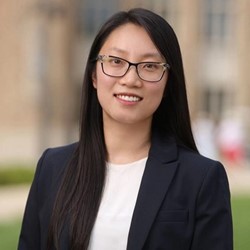
Chengcheng Zhai (Photo provided)
Chengcheng Zhai, assistant professor of IT, Analytics, and Operations at Mendoza, co-organized the workshop with Pedraza-Martinez. “Humanitarian operations is a growing field. As far as I know, this is the first workshop in the U.S. to exclusively focus on humanitarian operations research,” she said. “Hosting this workshop on campus brought the attention of experts in our field to the Notre Dame research community and to Mendoza.”
The small-format workshop featured two types of talks: The first highlighted early stage research, in which presenters shared ideas in progress. The second session format offered junior faculty 30 minutes to present work-in-progress to the group. Immediately afterward, a senior faculty member from a different institution acting as a discussant responded to the work, offering thoughts on the methodology, framing and how to make it even more polished before submitting it for review by a journal.
When Gloria Urrea heard about the workshop, she thought, “I can’t miss this.” An assistant professor of operations management at the University of Colorado Boulder Leeds School of Business, Urrea studies the operations of humanitarian organizations. “This is the place where I need to be to both share my research and receive feedback, but also to learn more about what others are doing in our field.”
During the workshop, she had the opportunity to present “Focused versus Diversified Nonprofit Organizations: Matching Operations Strategies with Donor Types”. After years of research, the paper was under review for publication at an academic journal, and she and her co-authors were actively preparing a revised version. Many of the senior faculty attending the workshop also serve on the editorial boards of top academic journals and were uniquely positioned to offer helpful feedback to tighten and shape a forthcoming paper.
Identifying nonprofit funding patterns

Harwin de Vries of Rotterdam School of Management at Erasmus University gives a presentation at the HOPE Research Workshop (Photo by Peter Ringenberg/University of Notre Dame)
The paper aims to understand what strategies non for profit organizations can adopt to access funding from large foundations and government institutions. Specifically, it examines how funders allocate major grants and gifts across two types of non for profit organizations: focused organizations, which concentrate on a single issue such as water conservation, and diversified organizations, which operate across multiple programs such as nutrition, and water and sanitation.
Jorge Mejia of Indiana University served as the paper’s discussant. “He offered us very good points about how to position the introduction, better clarify our framework, and how to strengthen our empirical approach,” Urrea said. Audience members also chimed in with additional suggestions. “It was extremely helpful as we were in the process of revising our paper and this feedback only made it stronger.”
Support and Connection
The experience was equally valuable to the discussants. Harwin de Vries, a professor at Erasmus University in the Netherlands, responded to “The Impact of Female Leadership on Water Point Functionality in Development Operations Management,” a paper presented by Zhai and co-authored with Kaitlin Wowak.
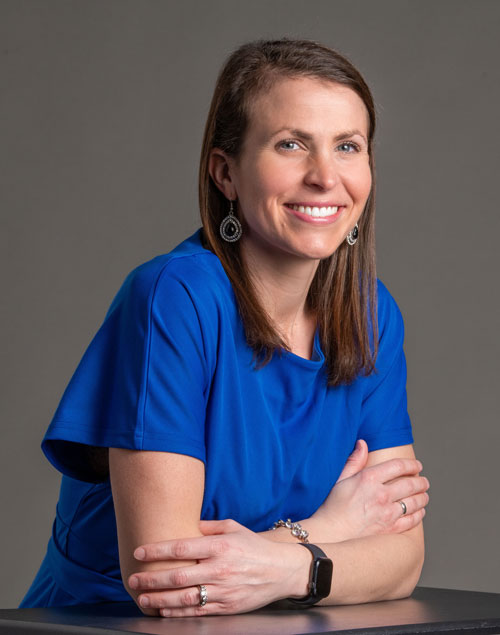
Katie Wowak (Photo by Barbara Johnston/University of Notre Dame)
“Discussion is a core part of academic life,” said de Vries. “We are trained to be curious and to think critically, and discussion is a key way to put that into practice. But such discussions often happen indirectly via impersonal reviewer comments and written responses to those comments. The workshop discussions offered a chance to do this in-person and at a much faster pace — almost like a miniature review process.”
Zhai’s research focuses on access to drinking water. In the paper she presented at the workshop, she used rural Africa as a case study. In many of these communities, residents travel to a shared water point and draw water from a communal pump. Women make up the vast majority of people responsible for sourcing water for their households. In most communities, a volunteer committee is responsible for maintaining and repairing the local water point.
Ultimately, the research concluded that when the committee chair is female, the water point will have a higher functionality, more working days and fewer manual breakdown days. “The results show that just putting females in the committee doesn’t really help. You need to put a female in a leadership role,” Zhai said.
De Vries offered important suggestions to incorporate into the research. After the session, Zhai also spoke with a number of other participants about her paper, gaining additional informal feedback that she and Wowak then weighed and incorporated into their paper when they submitted it for consideration just a month later. The researchers recently heard back from the journal with positive feedback and revision notes — likely the first step toward eventual publication.
HOPE’s Next Chapter

Chengcheng Zhai at the HOPE Research Conference (Photo by Peter Ringenberg/University of Notre Dame)
For Zhai and her colleagues at HOPE Lab, research is ultimately valuable only if it’s implemented. Noting that private sector operations research often isn’t successful when strategically applied in the nonprofit sector, she said, “Our goal is to help organizations make decisions that will help them to serve people in need. We want to help leaders make better decisions.”
Pedraza-Martinez envisions future HOPE Lab Research Workshops taking place on campus in the coming years, especially as the world faces increasingly complex humanitarian emergencies. “I think HOPE’s next chapter is going to be about informing organizations in the humanitarian sector on how to transition from the previous 60-year-old funding system to a new model of bilateral and multilateral aid,” he said. Thanks to the University of Notre Dame, we have the resources and the support to help.”