Bringing humans back into the equation
Finance professor Andrea Tamoni has devoted his career to understanding how the behavior of sophisticated institutions (and less-sophisticated individuals) shapes financial systems.
Published: January 6, 2026 / Author: Katie Gilbert

Andrea Tamoni has always been fascinated by what happens when unpredictable human behavior interferes with mathematical precision.
Paradoxically, this interest was sparked early in his career during the two years Tamoni spent immersed in the world of quantitative finance at Deutsche Bank. In the world of quantitative finance, movements in the prices of financial assets such as stocks and bonds are modeled like clockwork.
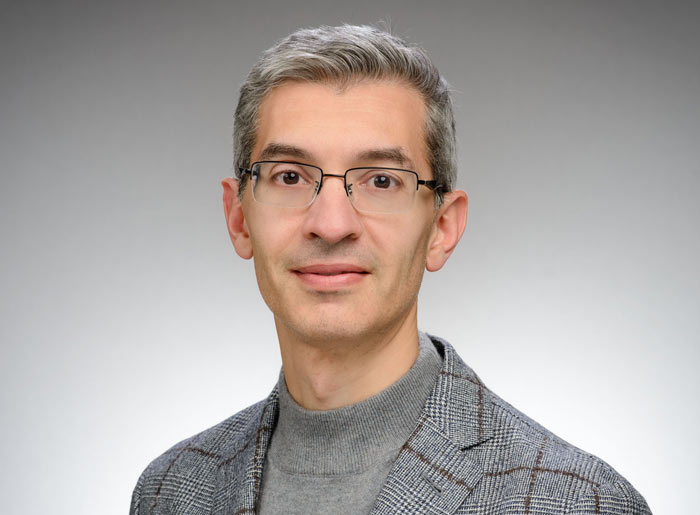
Andrea Tamoni (Photo by Angela Santos/University of Notre Dame)
“I watched other quants thinking about these movements in asset prices as processes, and trying to model them in a very mathematical way,” said Tamoni, associate professor of finance at the University of Notre Dame’s Mendoza College of Business. “But as I started reading more about economics and finance in general, I realized that behind these movements in prices, there are people. And those people are predicting what’s going to happen, they have their own experiences, they have to consider their own investment horizons.”
That revelation — that behind every data point is a decision maker, with habits, biases and expectations — set the trajectory for Tamoni’s research career. Since those early days, he has devoted his research to understanding how real human behavior, with all its messiness and intuition, plays out inside financial systems.
Over time, his work has played a part in pushing the field of asset pricing toward greater complexity, as he’s made a research case for moving away from models that treat markets as mechanical and toward frameworks that embrace uncertainty, human psychology and social interaction.
“Andrea’s work bridges behavioral, macroeconomic and quantitative perspectives,” said Carlo Favero, an Italian economist at Bocconi University and a frequent collaborator of Tamoni’s. “This has deepened our understanding of how structural and psychological forces jointly determine financial market outcomes.”
Now, as machine learning and artificial intelligence open new frontiers in research and economics, Tamoni finds himself at an inflection point. After all, these tools can process far more data and account for more variables than ever before, finally allowing the discipline to reflect the full, intricate interplay of human and institutional forces.
Still, Tamoni cautions against the temptation to let algorithms take the driver’s seat. His research findings over the years have helped to reinforce the early career suspicions he nursed while working among math-focused quants: Sophisticated mathematical modeling (especially the type that now powers AI) may amplify understanding, but it still needs human intuition to guide it.
“The statistical approaches are really useful,” he said, “but they cannot completely replace the human, economic understanding of what’s actually happening in the world.”
From Engineering to Economics: A Shift Toward Complexity
Tamoni’s fascination with systems began in engineering, where he earned both a bachelor’s degree (electronic engineering) and a master’s (telecommunications engineering). Soon, he found himself curious about another kind of system: the global financial system and its interconnected web of capital, risk and human decision making.
After his brief stint as a quantitative analyst at Deutsche Bank, Tamoni decided to return to school to earn a Ph.D. in finance, specifically to gain a better understanding of what, exactly, goes into setting asset prices.
He was drawn to the field of macro-finance. The fact that the discipline and its so-called “laws” refused to stay tidy and concrete appealed to him.
“Financial economics is complicated because it’s the output of social, behavioral and rational interactions,” Tamoni said. “In physics, there is a universal law and you can repeat an experiment and get the same outcome every time, proving the law is correct.”
In financial markets, by contrast, a given stimulus might produce different outcomes at different times. “You have to think about who the participants are and what the market structure is,” he said.
That curiosity led Tamoni to take a holistic view of markets and their inner workings.
He started with a research focus on demographics and how a population’s age, for example, might affect its economy overall.
“We were not interested in what moves prices tomorrow,” Tamoni said, “but in what might affect them over the next 20 years.”
His models examined how age cohorts move through life — accumulating savings in mid-career, drawing them down in retirement — and how those aggregate patterns ripple through equity markets.
“Younger people become middle-aged, the middle-aged become old, and the old start withdrawing money,” he said. “We found that these demographic movements, through saving and investing decisions, relate closely to long-term shifts in equity markets.”
The research offered insight not just for academics, but for pension funds and other long-horizon investors trying to understand how generational cycles shape returns.
Tamoni’s next line of inquiry focused on uncertainty and its cascading effects on markets. With Anthony M. Diercks of the Federal Reserve and Alex Hsu of Georgia Institute of Technology, he co-authored the paper, “When It Rains, It Pours,” which analyzed whether uncertainty shocks hit harder as one big event or as a series of them.
As examples, the researchers pointed to the 2016 Brexit referendum in the U.K. and the 2016 election of Donald Trump. Both events injected significant ambiguity into the global economy, prompting investors and firms to delay investment decisions.
“We found that the effect becomes much larger when we have a cascade of uncertainty shocks,” Tamoni says. “The more uncertainty there is, the more people wait and see; they stop investing, they stop consuming and they start saving to see what will happen. You can’t take one shock individually. It’s the sequence that magnifies the effect.”
From there, Tamoni turned to a question of growing practical relevance: Can investors actually harness the patterns economists identify?
In “Tradable Risk Factors for Institutional and Retail Investors,” Tamoni and his co-authors — Andreas Johansson of Lund University and Riccardo Sabbatucci of the Stockholm School of Economics — explored whether mutual funds and ETFs allow investors to capture the theoretical premiums documented in academic papers.
“Unfortunately, we found that a substantial part of those returns is eaten by transaction costs and other frictions,” he said.
The researchers named this gap between theory and practice the “implementation shortfall.” Tamoni said he hopes the concept is making an impact in both academic and investor circles.
“On the academic side, we were trying to push the profession to think more about these frictions,” he said. “And for retail and institutional investors facing this very large universe of funds, we proposed simple ways to construct portfolios that come closer to what academic research suggests.”
The Case for Human Intelligence
In recent years, Tamoni’s curiosity has turned toward artificial intelligence and machine learning — methods that promise to model complex systems with unprecedented granularity. Here, too, he has set out to establish the limits of sophisticated statistical modeling and understand how human intelligence can best work alongside it.
His 2019 paper, “Bond Risk Premia with Machine Learning,” co-authored with Daniele Bianchi of Queen Mary University of London and Matthias Büchner of the University of Warwick, used machine-learning methods to forecast bond returns by feeding in hundreds of macroeconomic variables, such as GDP, consumption, inflation and housing prices alongside bond yields at different maturities.
“We tried a very simple approach: Throw everything into the machine and ask for the best prediction,” he said. The team also tried something else: grouping economic variables into macroeconomic categories to help the machine learning model make sense of them.
The approach guided by economic intuition performed far better.
“These human-based classifications actually helped a lot,” he said. “We were surprised by how much the economic framework improved the machine’s forecasts. It showed that macroeconomic and financial variables both contribute, and that human guidance still matters.”
The paper has also shifted the conversation in the broader discipline about how machine learning techniques can be used in economic research, said Federico Bandi, an economist at Johns Hopkins and another frequent collaborator of Tamoni’s (though not on this particular paper). Bandi pointed out that the “Bond Risk Premia” paper has been broadly cited for the way it leverages novel machine-learning techniques to analyze a market beyond equities.
For Tamoni, the takeaway from using this tool was both humbling and affirming: AI is powerful, but only when paired with the interpretive frameworks built by economists.
Building Bridges at Notre Dame
This fusion of models with human scholarship extends beyond Tamoni’s research. As the faculty director of Notre Dame’s Institute for Global Investing (NDIGI) since March 2025, he’s leading an effort to strengthen the dialogue between academia and the investment industry.
“The primary mission of the Institute is to give visibility to the research we do at Mendoza to the practitioner world — to be a bridge between the two,” he said.
NDIGI convenes conferences and other events that bring students and scholars into conversation with asset managers from institutions such as Vanguard and Morningstar. The key goals: exchange ideas, gather feedback and ensure that research keeps pace with practice.
That integration — between models and markets, and between theory and application — reflects the very balance Tamoni has pursued throughout his career.
“When you can translate your research into a few sentences that are useful for students or practitioners,” he said, “That’s when you know you’ve connected the dots.”
Related Stories