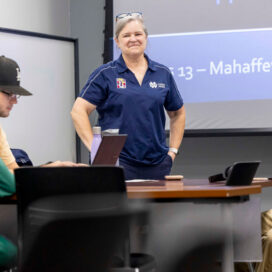
A treasured champion of students says farewell
Published: July 22, 2026 / Author: Courtney Ryan

Gina Shropshire (Photo by Matt Cashore/University of Notre Dame)
Gina Shropshire looks forward to Notre Dame’s graduation every spring. As an associate advising professor for the Mendoza College of Business, she hosts nearly 1,000 student advising meetings each year, so she is deeply familiar with the excitement, trepidation and joyful relief that color the commencement season.
This year was different, though. While the final sprint toward the end of the semester was underway, far more students than usual flowed into Shropshire’s office. Many broke down in tears, crying into their advisor’s shoulder. Yet instead of seeking comfort because of a stressful exam or difficult class, these students appeared in their advisor’s office to bid farewell to someone whose stable and affirming presence helped define their undergraduate experience.
On June 30, Shropshire will retire after more than 27 years with the school. It’s the end of an era that actually began much earlier when she arrived on campus as a freshman in 1978. She chose Notre Dame, first as a student and then as a professional, by following her curiosity and embracing the opportunities born from uncertainty. Not only has that outlook guided her career, but it is how she has guided thousands of students over the years.
“Whenever I’ve looked back on my career and thought that I should have done more to advance to a higher rank, it’s at that very moment that a student would come in and I would think, ‘Nope, this is exactly where I’m supposed to be,’” said Shropshire. “Because for some reason, that student needed to hear me that day. There was something I had to help them with.”
For the many undergrads who have been that student over the years, encountering Shropshire’s calming presence and level-headed advice has been as crucial for their education and future as any capstone course or gainful internship.
“Gina played a key role in shaping the foundation of my undergraduate success,” said Michaela Cooper (BBA ’27). “I recall stressing about a grade in a business class, and Gina reassured me that everything would work out in the end, that she believed in me, that no matter what the result of the class might be, she was there for me and we’d get through it together.”
Another student, Alexandra Sánchez Acevedo (BBA ’27), echoed Cooper’s sentiment. “I’ve always felt that she cared not just about outcomes, but about us as people and our well-being outside of classes, which made a lasting difference in my experience at Mendoza,” she said. “She has a way of making students feel heard and supported while also providing thoughtful, practical guidance.”
As senior assistant dean of Advising and Academic Operations, Andrew Wendelborn has often witnessed the impact Shropshire has had on current and former students. Football season, he said, is especially busy around the office as alumni often pop in to see if they can catch up with Shropshire.
“They stop by and say, ‘I never would have graduated if it wasn’t for Gina.’ It’s just incredible to think of all the students she’s worked with,” said Wendelborn. “For years, she’s been the cornerstone of the advising office. To have her retire is a big loss. Not just the institutional memory that goes with it, but also the steadiness that she’s given us as a team all these years.”
Shropshire has reiterated that she is leaving Mendoza students in great hands, and she is, but as she has demonstrated throughout her career, institutions are defined by the individuals who pass through them. And her individual impact is tremendous. When advising students, she is less interested in telling them how to check off the required boxes and more interested in helping them access their passion and what might drive their success.

Gina Shropshire advises an undergraduate student in her office. (Photo by Matt Cashore/University of Notre Dame)
“I encourage them to study what they like and what they’re good at,” she said. “Let’s say they’re a finance major, but what really charges them is performing. If a second major in musical theatre is what keeps their focus on academics for the next four years, then that’s great. There’s no right or wrong way.”
Shropshire’s empathy for students is informed by her experience navigating the same unknowns when she was a young, ambitious undergrad. As a high school student from Gary, Indiana, she knew what environment she wanted in a school: academically rigorous, not too far from home and not too big. She didn’t know what she wanted to study and chose Notre Dame in part because its freshman year studies program gave her time to decide before settling on a major.
“I always tell students that it’s OK if you don’t know what you want to do for the rest of your life,” she said. “It’s okay to be uncertain, because you’re going to have life experiences that are going to help you make decisions down the road.”
When Shropshire arrived on campus in 1978, only about 25% of the 1,700 first-year students were women as the school had only become fully coed in 1972. Among those women, only about 2.5% were Black like Shropshire. Having attended a majority white Catholic high school, she was familiar with such institutional homogeneity and turned her focus to adjusting to the intense rhythm of college work.
She also quickly bonded with a group of Black students, many of whom are still close friends today, and found mentors in Black juniors or seniors. Whether they realized it at the time or not, their day-to-day lives of going to class, attending games, joining clubs and studying abroad altered the school’s legacy and continue to impact students today.
“When I was here, alumni were the older white men who came back for football weekend with funny looking leprechaun pants,” she recalled. “To finally see women alumni, to see more alumni of color — I loved seeing that. One thing that’s different for students today is they see more alumni like me.”
Wendelborn has seen many students over the years connect with Shropshire’s background. “She graduated from Notre Dame at a time when students of color were not as prominent as they are now, and to be able to share that experience with students today who still may not feel completely connected when they’re here, I think, is a great gift.”
Among the most decisive moments in Shropshire’s life was the year she studied abroad in Angers, France. The opportunity to explore a different corner of the world while viewing the U.S. from a distance not only solidified her choice to double major in American Studies and French, it helped define how she encounters people with empathy and curiosity today.
“To see the United States from the outside in, to meet people from other countries and listen to their experiences was amazing,” she said.
As an advisor, Shropshire often encourages students to study abroad and serves as Mendoza’s undergraduate studies liaison to Notre Dame’s International Study Office. “At a moment’s notice, she can rattle off classes that are offered from London to Singapore and whether the credit will transfer back or not,” said Wendelborn.
After graduating, she briefly worked in corporate sales before returning to academia. She spent a few years in Gary teaching high school French, eventually receiving a master’s in French literature followed by a doctorate in education from Purdue University. As she considered her next move, she was open to whatever possibilities may arise, be it a tenure-track position or an administrative role at a university.
When the advising role at Mendoza landed in front of her, it turned out to be the ideal position. It was close to family in both Gary and Chicago, and even though there was a learning curve in terms of getting a handle on the business curriculum, that was a welcome challenge. It also meant working with the school’s diversity programs.
It was 1998, and Notre Dame had changed significantly since Shropshire matriculated 20 years earlier. Male students were no longer baffled to encounter women in their classes and on-campus recruiters actively sought out minority students to join their companies. She worked with the Diversity Advisory Council to encourage diverse students to major in accounting, finance and marketing, and she taught classes like Diversity in the Workplace. The role also meant educating faculty and staff by bringing more awareness to what diversity and inclusion really mean at an institution.
“I think inclusivity is making sure that students know the doors are open to them,” said Shropshire. “It’s seeing more upperclassmen, seeing more alumni, seeing administrators and people in place like me. That’s a way to help students feel like they can do this, they belong here.”
When she was in school, it was an older student who also came from Gary and also studied in France who demonstrated to Shropshire that she belonged, that it was possible to successfully pursue and navigate the academic experience she desired. As an advisor at Mendoza, she’s able to do the same for countless students.
Despite working with nearly 1,000 students each year, Shropshire remembers the individuals who pass through her office and is thrilled by every alum who returns to say hello.
“When you meet with Gina, the first thing you notice is her warm smile,” said Cooper, adding that along with her encouragement and guidance, she will especially miss Shropshire’s warm hugs and sense of humor.
“The relationships she built and the care she showed were genuine, and I think that is what made her so special to so many people,” added Sánchez. “Mendoza is losing someone who not only advised students, but truly shaped their experience and sense of belonging within the community.”
Though many will cry over her departure, Shropshire is excited to spend more time with family, travel, tackle remodeling projects around the house and, as always, embrace any unexpected opportunities. While she may no longer be on campus, her empathy and curiosity will linger with her colleagues and the many students she has inspired over the years.
“I hope my legacy is that I listened to students,” she said. “I hope I encouraged them to excel while knowing they’re not locked into one path.”
Related Stories